
Beyond Photogrammetry:
Photometric stereo.
Chapter 1
Photometric stereo is a technique in computer vision for estimating the surface normals of objects by capturing that object under different lighting orientations. It is based on the fact that the amount of light reflected by a surface is dependent on the orientation of the surface in relation to the light source and the observer. In our case observer is a camera.
Extremely simple and clever idea.
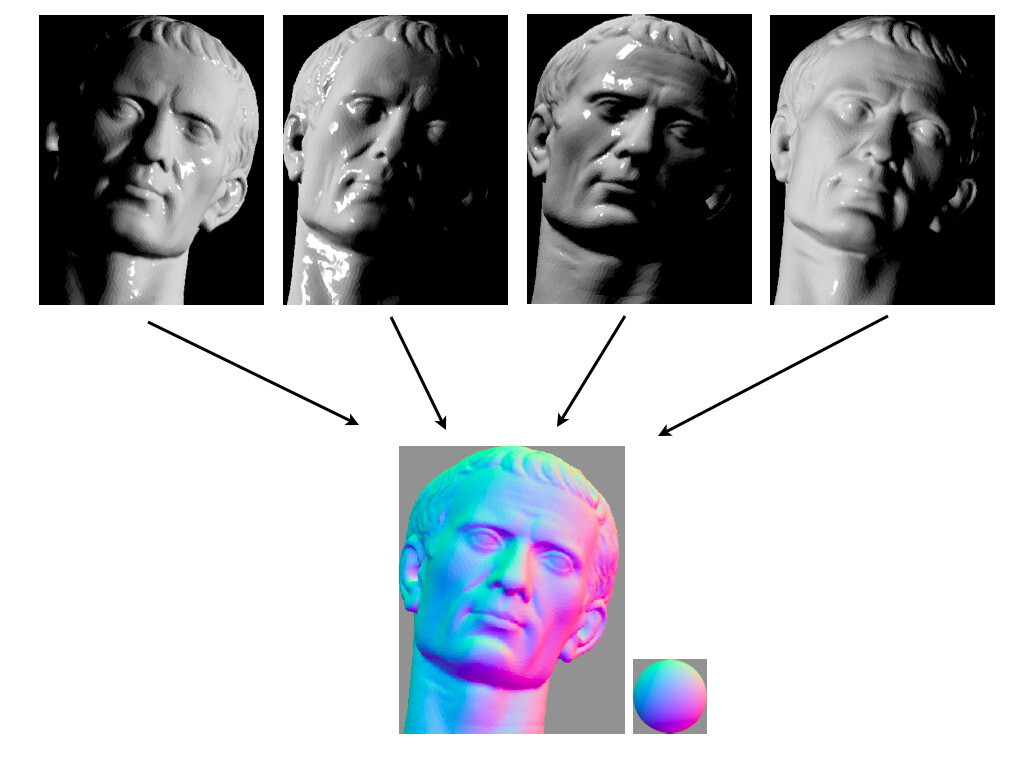
Most of people probably already have seen this definition and that image from Wikipedia (https://en.wikipedia.org/wiki/Photometric_stereo)
But for some 3D artists or scanners that may be still do not give an idea how this working. How actually we can use lights to estimate normals?
For that let's see inversed process.
For example, Boxing Glove scan. Left picture in first row is a matcap render, right one is common way to visualize surface normals. Last three images are R, G and B images is a just normals render split to separate channels.

Need more hints?
Let's check how this looks in grayscale.

Looks familiar?
R looks like white glove illuminated from right, G like illuminated from Top and B like illuminated from behind camera!
And in photometric stereo capture we just do same but with real object and real lights!